Archive
June, 2009 Monthly archive

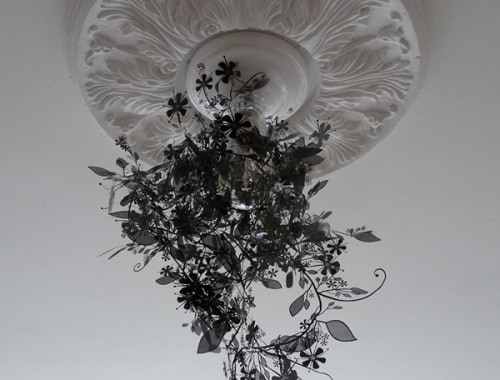
I’ve had a Tord Boontje Garland light (this is the black chrome finish) for several years, but for the most part it’s just been sitting in a tangled clump in a box since we moved into the house. The standard way to hang it is on a bare bulb suspended by a cord, but with our high ceilings, the proportions wind up looking really skimpy and just too dangly.

After spending a solid hour detangling the thing last night, I decided to try wrapping it directly around the bulb on a flush-mount fixture in the bedroom. This is the white porcelain Benedict light from Schoolhouse Electric. The glass socket is really beautiful, so I wrapped the Garland just low enough that it’s still visible.

I’m really happy with the result, and I can’t wait for it to get dark enough to check out the shadows it casts on the ceiling! I used an Edison Double Loop bulb for added effect (the light cast by Edison bulbs is very warm, dim and soft, and the bulbs themselves are beautiful—they’re perfect for mood-lighting in fixtures that have visible bulbs). The Garland itself is quite affordable, and I think it’s worth upgrading the light source to something more elegant than the standard plastic cord set that comes with it—in fact, you can even order the Garlands by themselves ($76 with cord/$64 without); you’re not obligated to order the cord set. If you want the effect of a hanging pendant, the Lewis fixture from Schoolhouse Electric (with a cloth cord!) would look fantastic.

By the way, “arranging” a Garland light so that it looks like the product photos is a total nightmare. It takes FOR-EV-ERRR. This post (which I found in a fit of frustrated Googling) sums up the experience quite accurately!

EDIT: Oooooh, nighttime shots! I’m in love. The shadow effect is so dramatic with the Garland this close to the ceiling! The moth-to-flame feeling of this light is perfect for summer nights, isn’t it?


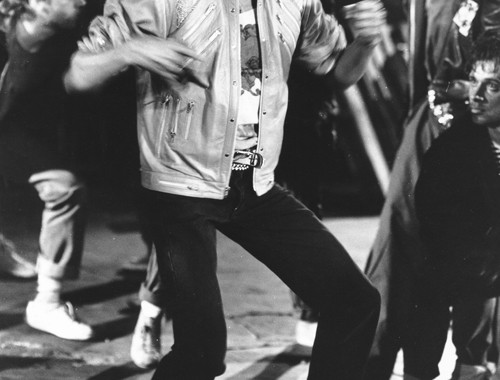
(Photo by Chris Walter, 1983)

I don’t normally post things like this, but I am feeling so sad right now that I don’t know what else to do. Bear with me.

I’m part of the generation that’s old enough to remember Michael Jackson from before he became a punch line, but young enough to not think of him as a child prodigy. When Thriller came out in 1982, I was in second grade. Michael Jackson was 24, and he was a sex symbol like no other. He was mysterious. He was cute. He didn’t look, sound, act, or dance like anyone else—he had moves, he was magic.

The only things I remember about second grade are that my teacher was Mrs. Loeber, and that Thriller was HUGE. It’s impossible to overstate how infatuated the entire world seemed to be with Michael Jackson in the early and mid-’80s, and he deserved every accolade he received (and then some).

If you’ve ever tried to have a conversation with me about Michael Jackson, you know that I am one of those people who will defend him to no end. It kills me that his so-called “weirdness” has overshadowed his truly stunning talent for so many years, but I’ve always been able to look beyond that and keep an intense appreciation for all that he contributed to music and entertainment and dance and fashion. I’ve never stopped thinking that he’s magic.

This is one of those DIY projects that kind of makes you feel like a jerk while you’re planning it, but the end result is so good that the shame is worth it. I’m really not a fan of knockoffs for a variety of reasons, but I just couldn’t resist.

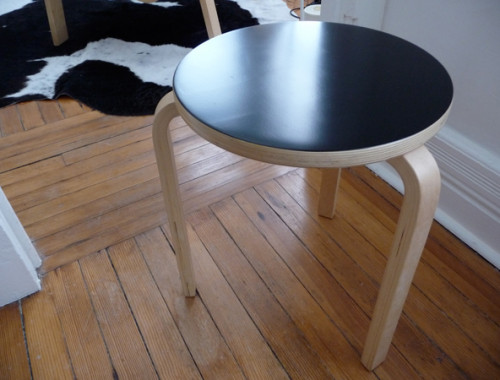
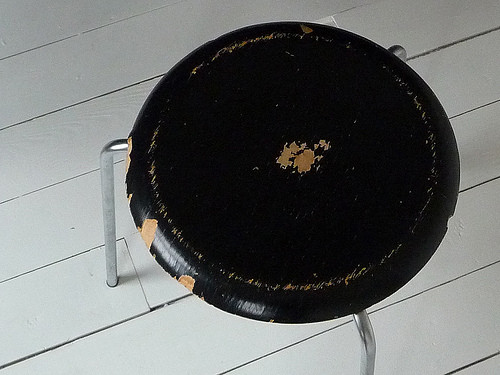
It’s not exactly a secret that the design of IKEA’s $12.99 FROSTA stool is, um, heavily “influenced” by Alvar Aalto’s Stool 60, designed in 1933 (and currently retailing in the US for $250–300, depending on options). The materials and construction are virtually identical, with the primary differences lying in the curvature of the legs (admittedly more elegant on the original) and the color of the finish—the Aalto stool is available in a variety of colors and with laminated tops. (Yes, the Aalto stool is also available with four legs, just like the FROSTA!)

Anyway, blah blah blah, I decided to nudge our two FROSTA stools just a wee bit closer to looking like the real thing. I mean, why not, right?

The first thing I did was convert them from four legs to three. One leg from each got discarded (I may use them as shelf brackets at some point), and the other two were repositioned. I haven’t owned a protractor since 8th grade, so I did what you’d expect a graphic designer to do in this kind of situation and figured out the measurements by making a pie chart in Illustrator! (I could have saved myself some time by reading Martha’s post on the subject, though.) I didn’t use glue or do anything fancy, I just drilled a tiny pilot holes and screwed the legs in place. Totally easy, anyone can do it.

The final step was painting the top of the stools black. I bagged the legs as I did here, then taped off the edges of the top very, very carefully. I like the Delicate Surfaces painter’s tape for things like this since it’s thin and allows for a really tight fit to curves. Two light coats of my favorite Rust-Oleum’s Painter Touch Ultra Cover 2x (this is the semi-gloss finish), and the stools were done!

All I’ve been working on lately are DOORS. Doors, doors, and more doors. Scraping, sanding, patching, caulking, priming, painting, hanging, fixing locks, fixing hinges, fixing knobs, and so on. (I must say, it’s very nice to not have to look at closet contents anymore! Doors are a good thing.)

One of the hazards of keeping a blog is that I have the ability to look back and see just how long it takes to me to complete simple tasks. Case in point…

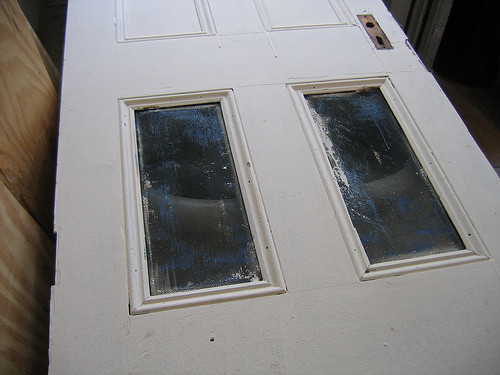
I posted this picture 15 months ago, when I first started working on this particular door. The bottom panels had been crudely cut out and replaced with screening (which had then gotten rusty and paint-y and dented and gross) at some point.

Back in September, I returned to working on the same door. I was still uncertain about the best way to go about replacing the panels. I had figured out that the door did not, in fact, belong on a closet, but rather in the doorway between the front and center bedrooms (both rooms are accessible from the hallway as well—we have a lot of doors).

Fast-forward (or slow-forward, as the case may be) to eight months later, and I’m WORKING ON THE SAME DOOR AGAIN. Only this time, I’m actually finishing it!

Whoever put the screening in obviously did so for the sake of cross-ventilation through the length of the house, and I admit that it makes a lot of sense. Radiator screening seemed like it would be much nicer than window screening, though, so I bought a sheet and spray-painted it white on both sides. The original trim pieces were missing on one side, but lattice strips turned out to be exactly the right width and depth to replace them.

I mitered the corners of the lattice and used short nails to fix the strips in place. After filling the nail holes, caulking the joints, and painting the whole business white, the door will FINALLY be ready to re-hang. (I’ll let you know when that happens. It could be next year sometime. Hah!)

Huh. I started putting this post together 4 or 5 days ago, and I guess I thought I had already finished it? I have no idea. It’s been a weird week. I spent about 8 solid hours priming and caulking doors on Sunday. It’s amazing how an entire day can be devoured by a single, simple task like that. Job-work has been busy but unusually productive, and evenings have consisted of painting doors, eating sushi, getting my hair cut, and sleeping through my stop on the train.

Anyway, this post is about windows! Well, one window in particular, the 42″ wide one in our (future) guest bedroom.

Yeah, it was looking pretty funky. Click to enlarge . . . if you dare!

I wanted to share these detailed “before” pictures to give an idea of just how bad an old sash window can LOOK while still being perfectly salvageable. It makes me sad that so many buyers of old houses will immediately have the original windows ripped out and replaced! ALL of the 15 windows in our house are original, including nearly every pane of gorgeous, wavy glass. I consider the old windows an asset that add to the value of the house as an historic structure.

The parts that comprise a traditional sash window are incredibly simple, making them easy to repair. There are no plastic parts, no fragile bits to snap or break, the wood is old-growth and rock-solid, and if you take care of them, they truly will last for hundreds (!) of years. Replacement windows, on the other hand, seldom have a life span beyond 10-25 years. With proper insulation and a good storm window in place, old windows are very nearly as energy-efficient as new ones, too. We have seen a HUGE difference in our energy costs since I started repairing the windows last summer.

I won’t bore you with a bunch of “during” shots, but i wanted to share this one so you can see what a huge improvement just removing all of the gunked-up old caulk and peeling paint can make. It’s tedious work, to be sure, but it’s also very satisfying.

Here’s the finished window (click the bottom photo to see the whole thing)! Amazing difference, right? Eventually I’ll have to access it from the outside to properly insulate around the frame (and to repaint the exterior side, which is a whole OTHER project), but for now, it’s like a new (old) window.

There are so many resources on the internet for learning how to restore old windows, so I don’t see the point in getting TOO in-depth with the details here, but I will give you a list of links to check out if you’re interested:

How to Restore Sash Windows
Making Old Windows Energy Efficient
Fixing Rotted Wood with Epoxy
The Repair of Historic Wooden Windows
How to Replace Window Sash Cords (video)
Sash Repair Hardware