Archive
Food + Drink

It’s no secret that coffee is one of my great loves, but it may surprise you to know that I don’t actually drink that much of it. Yes, I do have at least a cup (“a cup” = one container of finite size, not necessarily measuring 8oz) of it a day—sometimes two—but it’s not as though I’m guzzling it constantly or anything. I do think of coffee as a real pleasure, not just for the perkifying aspects of the caffeine it contains, but also the routine of preparing the coffee. The daily ritual. And it tastes darned good, too, provided it’s made right.

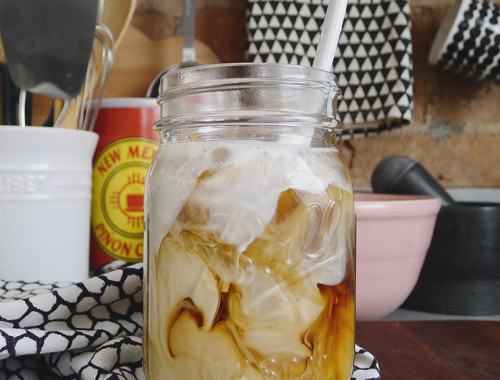
From around mid-May until mid-September, 95% of the coffee I drink is iced. While some people like to enjoy a cold beer when the air turns sultry, I prefer to sip on cold coffee (through a straw, please—bendy if at all possible). Sometimes I buy one on the go, but most of the time I make my own. Until recently, I’ve always followed a basic set of instructions: Brew a pot of coffee using double the amount of beans as you would for hot coffee, let cool, and serve over ice (or coffee cubes, if I’m getting fancy).

For the past few years, though, I’ve been hearing a lot of yammering about using a cold-brewing method for making coffee (most notably this New York Times article, Smitten Kitchen’s recipe, and the many accolades for the Toddy system). I tried it out a couple of times using a pitcher, a jar, and a strainer as depicted on Smitten Kitchen, but I honestly found the whole operation kind of unwieldy and messy…and the end result wasn’t fabulous enough to warrant the effort. So I went back to hot-brewing/cooling.

Enter the Bean Iced Coffee Maker from Bodum, previously seen on my “it list”. I’m a sucker for just about anything Bodum makes (beyond the classic French press everyone has, they also make an awesome toaster and the most practical laundry bag I’ve ever owned), so when I saw that they’d introduced a press specifically geared toward making iced coffee, my curiosity was piqued.

(Four paragraphs in and I haven’t even started the “review” yet. This is why it takes me so long to write posts!)

What, may you ask, makes this new press different from a regular French press for hot coffee? Well, for starters, the size. The largest hot coffee press Bodum makes is 34oz, but the cold-brew press has a 51oz capacity. That’s a pretty huge difference! There are also two lids included—one without a plunger in top so the whole thing can fit nicely in the fridge pre-plunge while the coffee is brewing. Both lids make an airtight seal so the cold coffee will keep fresh for days (no, really, it does!). And it looks cute, which is always nice.

Let’s get to the important part now: HOW DOES THE COFFEE TASTE? Friends, cold-brewed coffee, when done right, tastes awesome. Strong without being bitter, rich and full and caramel-y and with no aftertaste whatsoever. It’s like what you always imagine coffee is going to taste like with none of the disappointment.

The only real con when it comes to cold-brewing is that it does have to be done in advance. The grinds have to sit for at least 12 hours before pressing (we wait a full 24 hours because that works with our schedule—we usually only have coffee at home in the mornings), so it’s not like you can whip up a pitcher of coffee on a whim. Granted, you do wind up with several days’ worth of coffee at the end of the process, but it’s something to keep in mind. Also, I’ve never found washing French presses to be much fun…but it’s not so bad if it isn’t every morning.

I should also note that the coffee that cold-brewing produces is, at least in theory, concentrated. You can, therefore, be able to add water to it in your glass to create a beverage of exactly the strength you like. The reason I say “in theory”, though, is that apparently Evan and I are deranged freaks because we just drink the concentrate straight up—or at least straight up with some ice cubes and soy creamer. What can I say, we like strong coffee.

I can’t say that I’m likely to use cold-brewing as a substitute for regular drip coffee during colder months (I’m happy with my Cuisinart, and the thought of having to reheat cold coffee in the morning—before having consumed said coffee—is just too much for me to comprehend), but for iced coffee it really is a no-brainer.

And on that note, I’m heading off for the fridge now to pour myself a glass. Fortunately, we have a whole box of bendy straws on-hand.

Here’s the method I use for cold-brewing in my Bodum press:

• Measure 12 level scoops (scoop included) of medium/course-ground coffee into the pitcher
• Fill pitcher halfway with filtered water; stir until saturated using a wooden spoon
• Fill pitcher to 1/2″ from the top, put lid on
• Stick in fridge for 12-24 hours; press

That’s it!


“David Lynch Signature Cup Coffee” commercial // Directed by David Lynch, 2011

This is, by far, the finest commercial ever made. Really—watch this (the whole thing) and tell me you don’t want to run out and buy a bag (or a dozen bags) of David Lynch Signature Cup Coffee RIGHT NOW. Even if you’re not a coffee drinker. You want it, right?

A few months ago, Daniel and I went to see a movie* at the IFC Center, and I noticed David Lynch’s coffee for sale at the concession stand, and even though it was in no way presented as a being a joke product, I was kind of baffled by its existence.

Well, no longer. It all makes perfect sense to me now. You know, in the same way that Mulholland Drive and Lost Highway make sense. As in, not at all. But it’s good anyway, and my life won’t be the same without it.

I love David Lynch. I also love coffee.

*We went to see Tiny Furniture, and it was very enjoyable. The 24-year-old writer and director is also the protagonist, and her real-life mother and sister play her movie mother and sister and the whole thing is set in her mother’s (GORGEOUS AND AMAZING) real-life apartment—yet the entire thing is fictional. And she made it for $25,000. Recommended!

bokchoy & tofu

The other night I was gazing longingly at Isa Chandra’s avocado, basil and peanut stir-fry recipe, wishing I had all of the ingredients on hand but knowing there was stuff in my fridge (hi there, baby bok choy!) that I had to cook before it went bad. Using the basis of her stir-fry sauce recipe as a guide, though, I put together a really fast and easy little meal that I’m sure I’ll make again. You don’t even need to use bok choy, of course, that’s just what I had—any other combo of veggies would be fine (broccoli, peppers, onions, shredded carrots, or even kale, if you’re hardcore). It’s really the sauce and the crispy tofu that hold it all together.

BABY BOK CHOY WITH CRISPY TOFU (vegan)
Serves 2

1 tsp peanut oil
8oz extra-firm tofu
3 heads baby bok choy, ends trimmed
salt
1 tbsp black sesame seeds

noodles or rice

Sauce:
2 tbsp mirin
1 tbsp soy sauce
1 tbsp agave syrup
2 tbsp water
1 tsp Sriracha sauce
1 tbsp freshly grated ginger
2 cloves garlic, minced

Heat the peanut oil in a cast iron pan on medium-high heat. While it’s getting hot, slice the tofu, press out the excess moisture with a towel, then cut it into cubes. Sprinkle with a little pinch of salt (and maybe a little Japanese seven spice, if you have it) and toss gently to coat with oil. Let the tofu cook for 5-7 minutes, tossing every couple of minutes, until it’s nice and brown on all sides. Set tofu aside.

Keeping the pan on medium-high heat, add the baby bok choy and a little bit of water (maybe a tablespoon)—just enough to get some steam going. Cover the pan and let the bok choy cook for about 5 minutes, tossing occasionally. It will shrink down considerably as it cooks, so don’t worry if it seems like the pan is overstuffed at first.

Combine all of the sauce ingredients in a small bowl and add to the pan with the bok choy. Sprinkle in the black sesame seeds. Once the sauce is bubbly, add the tofu back to the pan and let simmer for another minute or so—the sauce should thicken up a bit.

Serve over noodles or rice!

bokchoy & tofu prep

Today I was talking to my friend Janet about being tired after work and not feeling like cooking, and I followed up with a bit of my usual bragging about how I can make a decent dinner in as little as 5-10 minutes (sometimes even that seems like too much, though, which is why Chinese delivery exists). It’s true! I can make dinner that fast! And I do it all the time, especially if Evan has to work late or run an errand in the evening.

I hate to waste food, so my first priority with quickie-dinners is to use up scraps. I never use a whole block of tofu when I’m making a recipe, and if I put the extra back in the fridge, it inevitably goes bad before I get to it. I’ve learned a trick, though, and that’s to freeze it! Cut it into strips, press out the excess water, put it in a baggie or container, and stick it in the fridge. It’ll turn a weird yellow color when it’s frozen, but that’s okay. Just make sure you take it out of the fridge with enough time to defrost before you want to use it! The coolest part about freezing tofu is that it totally changes the texture—it goes from being soft and wet to being kind of chewy and spongy. You’ve probably had tofu like that before in restaurants and wondered how to make yours taste like that. Now you know! It’s awesome.

I’m also a rice-hoarder. When we get delivery food, there’s always about double the amount of rice included in the bag than we could ever use in one sitting, so I save the leftovers. If I’m cooking rice, I make extras. If you know you’ll be eating the rice within a few days, you can put it in the fridge—otherwise, freeze it. It’s so nice to have rice all ready to go when you want it.

So here’s what I made tonight, since I was smart and remembered to take the tofu out this morning. It literally took 10 minutes, and only about 5 of those minutes were spent doing anything related to preparing the meal.

SUPER-QUICK TOFU & ASPARAGUS (vegan)
Serves as many as you need to

extra-firm tofu (cut, pressed, frozen and defrosted)
asparagus
leftover rice
sesame oil
Japanese 7-spice (or some kind of spicy seasoning and sesame seeds)
Sriachca sauce

Put some sesame oil in a cast iron pan and put it on a medium-high burner. While the pan is heating up, wash and dry the asparagus. When the pan is hot, drop in the tofu strips and the asparagus—I like to do everything in one pan. Sprinkle with 7-spice.

While the tofu and asparagus are cooking, heat up the rice in the microwave (I know, I know…you can do it on the stove, too, but I usually put it in the microwave in the same bowl I plan to eat out of to cut down on dishes). Stir in a tiny drizzle of sesame oil and set aside.

Flip the tofu and asparagus after about three minutes. Keep an eye on it so it doesn’t burn. When the tofu is nicely browned on both sides and the asparagus is bright green with a little bit of char, slide everything on top of your rice. Serve with a healthy squeeze of Sriracha sauce, and maybe an extra sprinkle of 7-spice.

DONE. Ten minutes from fridge to table, one pan, and one bowl. (See?)

grits and collards

As a New York vegan Scandi-Jew who’s never set foot south of Maryland, I fully realize I have no business even uttering the words “grits” and “collard greens”, much less posting a recipe for them. I apologize in advance for what I know is a complete bastardization of two traditional soul food staples.

The fact of the matter is, though, this breakfast is vegan, relatively healthy, and really, really yummy. Like, ridiculously so. Evan and I both wanted second helpings as soon as we’d finished, and I think I’m going to make this again tomorrow morning. And maybe for dinner one night during the week. SO GOOD.

Southern Americans, you may wish to avert your eyes…

SAVORY GRITS (vegan)
Serves 2

3/4 cup water
3/4 unsweetened, unflavored soy milk (almond or rice milk are also fine)
dash salt
1/2 cup corn grits/polenta (NOT instant—see photo below)
1 tbsp Earth Balance
2 tbsp nutritional yeast
1/2 tsp garlic powder
1/2 tsp onion powder
freshly-ground black pepper
hot sauce (I like Cholula)

In a small pot, bring the water, soy milk and salt to a boil. Reduce heat to medium, and whisk in the grits. Cook for 5-7 minutes, stirring frequently. Reduce heat to low. Stir in the Earth Balance, nutritional yeast, garlic powder and onion powder. Turn heat off, cover, and allow to cool for a couple of minutes. Serve with ground pepper and hot sauce to taste.

COLLARD GREENS (vegan)
Serves 2

1/2 bunch collard greens
1/2 tbsp olive oil
1/2 tbsp Earth Balance
2 cloves garlic, minced
dash salt

Wash and dry the collard greens well. Trim out the center stalk. Stack the leaves and cut into strips.

Heat a cast iron pan over medium-high heat. Add the olive oil and Earth Balance (reduce the heat if necessary to prevent smoking), then toss in your greens and garlic. Sprinkle with salt and sautée until tender, about 10 minutes.

Notes:
→ If you’re cooking both dishes (they taste GREAT together, so I recommend making both!), start cooking the collard greens right after you add the grits to the boiling water/soy milk.
→ Next time, I’ll probably double the amount of collard greens. The recipe is enough for the amount in the photo, but I like a lot of greens—even at breakfast.
→ Don’t buy instant grits or pre-made polenta. You’re looking for dry polenta/corn grits—see below:

polenta